Monday, May 16, 2011

A Perfect Storm Threatens to Kill A Lagoon in Rio

At the beginning of autumn in the southern hemisphere, I walk with minha querida hand in hand around the Lagoa Rodrigo de Freitas in Zona Sul. The Lagoa is a constant source of inspiration since my arrival. Its mirror-like calm offers solitude amongst so much noise. The placid water stills the frenzy of the cars crowding the streets. 

Lagoa Rodrigo de Freitas

When the Portuguese arrived in the late 1500s, the local Tamoios called the lagoa Piraguá (motionless water). Later, the Portuguese landowners attempted to farm sugar cane on its banks with help from the tribes. Legend tells us that the farmers insisted on converting the natives to Christianity and making the natives wear clothing. They preferred not to and left. In any event, the farms never took root.

In the 1600s the lagoon earned its present name with the marriage of a local bride to a cavalry officer, Rodrigo de Freitas. Presumably the dashing young captain walked hand in hand with his intended on moonlit nights.

 photo by Delma Godoy 
gassa e logoa

Today, the lagoon serves as a focal point and forms the nexus of several rivers flowing from surrounding underground rivers fed from giant waterfalls in the hills. From the lagoon water spills out past Ipanema to the open sea.

On all sides of its 8k circumference, the lagoon supports a vast recreational community in one of the most densely packed cities on the planet. Each day thousands of runners, walkers, bikers and those on a promenade use every inch of the space. There are private nautical clubs, sports courts and an array of cafes, along with a busy heliport. Since Christmas 1995, a monumental illuminated Christmas tree floats across the mirror d'água, drawing thousands of spectators each night during Christmas.

What many paintings and tourist photographs do not capture is the severe stagnation and pollution below the water line. 

This is a longstanding problem. In 1922, it took the Centenary of the Independence to stir enough local interest to renew the lagoon and solve the problem. Inevitably, the lagoon was rebuilt but then it became severely polluted once again over the decades of government negligence. In the 1960s  a favela grew up along its banks until a fire destroyed it.  Developers moved in with landfill and began to build new luxury apartments and roads.

More construction is set to take place now that the lagoon is expected to become a jewel in the crown during the Summer Games in 2016. This is good news for the private clubs that have established themselves on the lagoon, including the Flamengo Club, the Brazilian Jockey Club, the Garden of Alah and the Naval Club on the island of the Piraquê.

Though a fisherman's colony barely survives near the edges - creating an illusion that all is well in the water -  the lagoon is a victim of chronic toxic waste.

Soon after Carnaval 2010, the lagoon began to smell badly. Days later, scores of boats appeared on the water with city workers pulling out 500-800 tons of dead fish. Early reports from the wildlife managers of the lagoon suggested that too much seaweed had robbed the water of oxygen during a period of high temperatures.

After this event, the water of the lagoon overrode its banks during the Easter floods, killing more fish and waterfowl. The lagoon could not revive itself. Nature had been overcome by seepage from old pipes pushing more contaminants into the sludge of the lagoon. The private clubs, restaurants and concessionaires have all contributed by dumping pesticides and other chemicals to keep their grasses and bushes green and bugs at a distance from humans. All it took, perhaps, was a record four degree rise in temperatures over the summer to set off the chain reaction.

The question to ponder for many who frequent the lagoon today: Would you let your child swim in the same water that killed thousands of fish? Would you eat a fish from the lagoon? If not, why should a bird expect to survive here?

 photo by Delma Godoy  

As I walk around the lagoon I see fewer waterfowl lining the docks. There are fewer flights of ducks and hawks. Only the scavenger birds fly now.  If you hear the call of a heron, count yourself lucky. When the fish and birds are gone, you are the only one left on the food chain.

Saturday, April 30, 2011

A Touch of Brazilian Magic


Throughout my stay in Rio I found that there was rarely a day I did not see or hear a futbol being kicked somewhere. All too often I could hear players yelling from a nearby club where balls bounced heavily on a concrete wall next to our bedroom.

Occasionally on the street I would run across a ball that had been kicked over a fence from a nearby sandlot. Wearing sandals I took my time kicking it back. At 40 Celsius I was contented to retrieve balls. Sometimes a ball found its way through a crowd at Ipanema beach, arriving at my feet, enticing the soccer player within to show his stuff. “Come on, man.” Instead I put a foot to the ball and made a simple pass to a dozen or more young people who had a lifetime of show-stopping heroics ahead of them.

Wayward soccer balls have always had a way of finding me, then urging me to come back to the sport if only for a moment of reflected glory. I had kicked makeshift balls made of rubber and clothing strung together, playing on a makeshift field near a village on the way to Mt. Everest in Nepal. Once I found a game in Guatemala City when a team needed a player to even a side. In Mexico at high elevation I played a portion of a game before the altitude got to me and they made me a referee for the rest of the game. In England I played games on a village road well into the night with two brothers keen to have someone to play with. As a youth in Colorado, decades before soccer became popular, I kicked a ball against walls and fences as a way of seeking equanimity in a turbulent world of my own making.

One night while walking along a beach in Cabraglia in the state of Bahai, I came across a game being played on a worn tennis court. The players wore old tennis shoes and some played barefoot, yet their skills were well advanced at a tender age. Then extraordinarily an errant ball flew into the air and bounced well out of bounds and came to a stop on the sand, confronting me. Giant waves from the Atlantic crashed not a few meters away in the last light of day. This particular ball dared me to take it ---skillfully. The young men were watching. I knew that local custom demands that when a ball arrives it is imperative to control it with style. Wearing sandals I flipped the ball on my right foot. Then I put the ball to my left foot and guided the ball back along the pavement, bringing it back to the eager players anxious to get on with their game.

I coveted the moments. This was no ordinary ball. It was the sum of all those feet that had touched it over its time. I passed on my inside left foot to their coach standing on the sideline 20 meters away. He nodded as he guided the ball effortlessly from his foot, up his leg as if it were on a string, bounced it on his knee and in mid-air, shot it flying back to the young men. The show was as much for me as for the players. 

With a respectful glint in our eyes two old warriors shared a touch of Brazilian magic with the future, the present and the past.


 Photo by Delma Godoy

Along a beach in Cabraglia

Tuesday, September 14, 2010

Lula's Spending Spree Catches Up To Brazil


Rousseff 's & Lula's Big Secret

Over the past couple of years President Lula been active on a farewell tour of the world proclaiming new social programs he sponsored in the name of international charity and goodwill. Lula hopes the history books will be kind to him.

Subsequently, he lent Fidel Castro billions of Reals to rebuild Cuba’s crumbling cities. Lula gave Reals to build roads in Bolivia and spent billions more in Venezuela so Hugo Chavez could rebuild the transportation system. Lula also forgave 700 billion in defaulted loans to several African states.

While he was on his multiple worldwide tours he was also brokering trade agreements, including business deals to bring nuclear energy to Brazil, as well as creating more hydroelectric dams in the Amazon. He made an agreement with the Russian space program for future space exploration. In all of these agreements, Lula rarely disclosed the amount or terms of these deals to his government.

Claiming national security reasons for his fiscal privacy, Lula invoked medidas provisórias, a measure which would allow him to act on behalf of the government without Congressional approval. Yet, legislators were concerned, because medidas provisórias was mandated by the Constitution only to be used as a tool by the executive branch to assist in making quick decisions in times of emergencies.

Yet, while Lula was traveling and proclaiming Brazil’s bright economic future, he never spoke about any “economic emergency” in Brazil. In fact, Lula was presenting Brazil’s economic miracle to the world in the best possible light. He even used the measure to improve the publicity concerning a Formula One race being held in Sao Paulo.

In the past, medidas provisórias was used by former president Fernando Henrique Cardoso in his first term just three times. The Real was under stress and devaluing during a time of high inflation. President Cardoso used the measure to bypass Congress to stabilize the Real using medidas provisórias. His quick actions eventually created the bedrock that would lift Brazil into prominence as a world economic power.

 Former President Cardoso

Lula, who led the opposition against Cardoso at the time, charges that Cardoso was becoming a dictator. Years later, Lula adopted Cardoso's economic framework himself and used the controversial measure 16 times in his first term. Since then, as president, Lula has used the measure on average of four times a month.

As much as Lula tried to hide his government’s fiscal management, it eventually came to the surface near the beginning of Lula’s second term on April 7, 2006. Minister Dilma Rousseff, acting on behalf of Lula’s government, made a decision not to loan VARIG, the beleaguered national airline, any more money to operate. Lula was busy telling everyone else in the world about Brazil’s economic muscle while Rousseff was secretly telling VARIG Lula could no longer support the company because the government did not have the money. VARIG, a respected airline, which dates back to the origins of aviation, was out of business, and 11,000 jobs were lost in Brazil. At the same time, Lula came up with $R 170 million to pay to international bankers as interest on overdue loans.

Of course, much of this information is conjecture and based on rumors and speculation. This is because the Lula government was operating in violation of the government’s own fiscal transparency laws. The media never complained and few judges would go against Lula in the courts and investigate these claims of corruption. And nothing changed. To Lula, there was simply no reason for transparency simply because he did not feel he was accountable.

Initially, there was protest led by Jose Serra, an opponent who had lost to Lula in 2002 and again in 2006. Serra called for an investigation by the Judiciary saying that Lula’s financial chicanery was a clear violation of the Constitution. Without the support of the Lula-dominated media, the protest came to naught.

On the eve of the 2010 election, the powerful Lula government propaganda machine continues to promise a prosperous future that would be fueled by vast oil deposits, nuclear power generation and hydro projects in the Amazon. However, the world is watching closely. The experts understand that Brazil’s promise is not immediate. It could take another two decades before Brazil could generate enough electricity to determine affordable market prices and reasonable costs to the average consumer. In some quarters, Lula’s promises for immediate revenues are sounding hollow.

Currently, much of Brazil’s economy remains based on its exports, but the country no longer has the leverage it once had because inflation within Brazil is hurting foreign sales with higher costs. Traditional revenues from its cash crops are slumping as the worldwide recession continues to linger, and other countries such as Vietnam, China, Turkey and India continue to batter Brazil with competitive pricing.

 Presidential Candidate
José Serra

José Serra and Dilma Rousseff may never meet in an actual debate. If they did, a couple of questions would determine each candidate’s approach to the next government’s economic policies: How will Brazil pay its bills? If Brazil were to default on its loans, what will the government do?

This election is not about the economy, but it should be. Perhaps this is why former president Fernando Henrique Cardoso decided to make a rare appearance recently on the Internet. Events have reached such a critical moment that Cardoso felt it was necessary to come out of retirement to warn his countrymen of the impending economic catastrophe that awaits the next government.

Cardoso, who is the architect to bring stability to the Real, led a government which went on to lead Brazil’s booming economy into the new century. Cardoso warns that the present government has acted for far too long as if it were making simple transactions. He says the matter is not about fiscal privacy. It is about disrespecting democracy. By continuing to circumvent the Constitution and ignoring the laws of Congress the “current president” has shamefully abused the voters and the election process. There will be serious economic consequences, he adds.

By the time of the elections, the voters themselves will be feeling the pinch of an economy gone sour. All across Brazil, the department stores in shopping malls are losing retailers. Restaurants are closing and cultural events are losing attendance. Auto sales are decreasing while basic costs like grocery items are increasing daily. Imported goods are fueling inflation. The roads are still not fixed in Rio and in other large cities more and more people are out of work incapable of paying their bills. Little or no work has actually begun on the large number of ambitious infrastructure projects promised to be completed for the 2014 World Cup or the 2016 Summer Olympiad.

What if Brazil does not have the money?

Friday, September 10, 2010

Brazilians facing a strange election

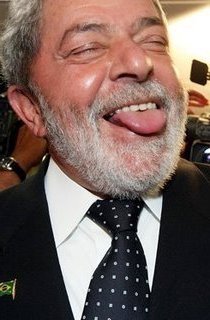
President Lula

On October 3, 2010 a presidential election will begin in Brazil. It will be the most important election in the country’s history. At stake is the country’s economic growth, its social policies, its civic institutions and democracy itself.

The outgoing President Lula will leave office basking in unprecedented popularity, backed by the powerful media elites he pretends to despise.

Harboring a long-standing problem with alcohol, Lula spent more time traveling than running the country. He made some 102 travels amounting to 382 days out of the country and 602 days away from Brasilia, the country’s capitol. Lula spent 984 days out of the Palace of the President. In total he spent nearly 82 percent of his mandate of 1,201 days traveling instead of governing the country.

Lula is inarticulate, choosing base words and crude antics when he faces opponents. Many educated people say his Portuguese is poor, and his grasp of the language is seldom above a grammar school level. Yet, Lula has effectively positioned himself as a peasant fighting the elites to make up for his intellectual defects.

Lula is nothing if not a showman. He did not wait to leave office to introduce a motion picture of his life in October of 2009. In the bio-pic, Lula, he was portrayed as a poor boy rising to the most powerful position in the country.

During Lula’s past eight years as president, he has based his economic and social policies on those of his predecessor, former president Fernando Henrique Cardoso, the man who first brought stability to the newly democratized Brazil. The Lula government, however, has claimed all credit for Brazil’s growing economy and has blamed the country’s faults on Cardoso’s previous administration.

At the same time, Lula’s government has spent ten times more than the Cardoso government had spent in its two terms. His excessive spending has drawn little criticism, as both houses of Congress willingly grant the president any amount he wishes.

Should he face any serious opposition for his policies, Lula will use secretive executive powers to circumvent the constitutional process if necessary. Recently he over-ruled the Judiciary when several judges made court decisions that opposed the construction of the Bel Monte damn. Not only has this caused a constitutional crisis that is still unresolved but the construction continues under a cloud of jurisdictional confusion.

Perhaps his most notable impact was made recently when he announced Dilma Rousseff as his successor. This in itself should have been a controversy, but Lula’s control of the media has made her untouchable to complaints. A recent law was passed in Congress forbidding any criticism or unnecessary scrutiny of the candidates for this election, including satire. Rousseff’s opponents now must debate her with their hands tied by executive order of the president.


Heir apparent, Dilma Rousseff

Ms. Rousseff, though intelligent, is not a crafty debater and often is perceived as clumsy. In response, the election debates are highly orchestrated. In some cases the videotapes are heavily edited to make her appear as the preferred candidate before they are released to the mainstream media. She is never available for sound bites or spontaneous discussions among the public or media.

Rousseff is a woman who has been plucked out of nowhere to be the next president of Brazil. She is paraded around by Lula as his successor and all but crowned as the new president. Lula claims she is winning the election by a margin of 50 percent to 29 percent in the polls.

All that is known about her is that she has some minor legislative experience and did not rise from the judiciary. She does not have a strong enough power base to become a senator and her legislative goals are murky.

At times, Rouseff appears to some skeptics as a novelistic character whose past has been rewritten to fit the times and circumstances. She has prospered under the wing of her mentor, Lula. She has steadily moved up through government as an appointed minister and has, like Lula,  taken on the guise of a misunderstood public servant; just another common person who has made good.

But even as her controlled election campaign continues unopposed, there is more evidence she was a middle class radical who later became a terrorist. Much of her history been lost under a new narrative created for her by the state-controlled media: This new Dilma has been redeemed and resurrected as a better person. This is a popular theme in a country dominated by Catholics.

Rousseff, herself, has refused to discuss her redemption or her mistakes of the past with any credibility. Rather, she has undergone several makeovers, softening her once unpolished and frumpy public image into that of a modern, well-to-do elitist on the move up.

Often, her color photos appear on the fashion magazines as a perky government leader. In this capacity she is interviewed more about her choice of toe nail polish than she is of her beliefs about her priorities for governing 290 million people.

While she has been effectively sheltered by Lula, from time to time reports emerge from the Internet that reveal a different Dilma Rousseff.

These reports document her association with guerilla groups in the 60s and 70s, when she was involved in murders, bombings, assassinations and bank robberies. Most notably, it has been reported that she was briefly imprisoned and was released without receiving the same treatment as her conspirators, who suffered much longer prison terms and torture. Some reports indicate that she took more than R$2.5 million from a bank robbery and used it to fund her fledgling political career.

 Dilma the guerilla

Most of these claims are disregarded by the mainstream media. The opposition has only hinted of a dark past with few specifics. In any event, there is no public outcry for a full investigation about Rousseff’s past.

The only stain on her rise to power may have happened during the first week of September when she appeared at a political rally with Lula. When she came out the crowd continued to cheer: “Lula, Lula, Lula” . Lula gloated despite efforts of the organizers to make the crowd yell “Dilma, Dilma, Dilma”.

It may be that her only opponent in the election will be Lula himself, who is showing signs of reluctance about leaving office. He seems unwilling to relinquish his place in history to his successor. This makes many in Brazil fearful that Rousseff will be the puppet and Lula will pull the strings. This reminds many of a well meaning politician in Venezuela who promised democracy and turned it into tyranny: Hugo Chavez.

Monday, July 19, 2010

The Art of Being Empty

pensamento mudo


Lygia Clark


After watching my inspiration turn to ennui recently, I received a note from my Muse, herself a highly respected plastic artist and painter in Rio. It was about Lygia Clark, a Brazilian plastic artist who frequently explored the emptiness of form in her work. Clark wrote that artists must not worry when they feel empty, because this is a natural condition for creative people.

Only when an artist is full are they ready to create, much in the way a person eats too much and they explode (vomit) in a furious burst of creative and emotional energy. What results is a large amount of painting, sculpture, music, etc. coming from the artist.

Filling up, Clark adds, is a process that takes time. It cannot be conjured up on a schedule; it means painfully collecting inspiration from routines among daily life: washing the clothes, taking walks in the neighborhood, having a quiet coffee in a shop alone, buying groceries, or just sitting on a bus while returning from work.

This is good to know because I often putter, waiting for inspiration to replace the emptiness. This means I cook, clean, sort, walk, nap, ponder, and move objects around a small basement apartment.

By contrast inspiration is a feeling of fullness. Often, but not always, the words begin to flow like water coming out of a fire hydrant. My best writing comes from making myself a “full” vessel, allowing the gods to pour their words into me.

Then for the next few days and weeks the cat or dog may not get fed. If I do buy food I might leave part of the groceries on the bus, along with gloves and umbrellas. The laundry does not get done. No one is dusting or vacuuming the carpet. I seldom make good conversation while full of inspiration. My circle of friends gets smaller.

In my fullness my characters jump off the page; they are extraordinary in their hopes and desperately seeking something beyond their grasp. They love and want to be loved. They face conflicting motives by what they try to conceal during the day and what they fear losing at night. They make a journey of discovery and then rapidly fade to black.

Implied in Clark’s statement is the notion that inspiration is found in daily life and that life itself is art.


Tuesday, July 6, 2010

Reality Returns In Brasil's World Cup Loss


Even Christo on the Corcovado opens his arms in frustration trying to coach the Brasilian team to the 2010 Copa. You can see the disappointment on his face.

My friend tells me that players from Paraguay, Chile and Argentina were warmly cheered by thousands of fans when they returned to their home airports. In Brasil, however, the players were forgotten by their fans and their coach was fired soon after returning home. The media is now creating a new tempest by arguing about the hiring of the next coach. My friend says that Brasil really doesn’t need a coach. “Everyone in Brasil is a coach.”

She is most pleased that Brasil is not playing in the finals of the 2010 Copa. “Now the country can get back to reality.” By this she means the people can begin to look more carefully into the upcoming elections in October, because President Lula will be deprived of taking all the credit for coaching Brasil to the World Championship. “Lula has claimed credit for everything else in the country, why not the Copa?”

Lula was openly critical of Dunga as coach before the Copa began and now has no one else to blame. Hopefully the president will turn his attention to inflation, joblessness and corruption, which is a principal issue in Lula’s presidency, she says.

She and many others want the media to investigate Lula’s manipulation of finances in which he chose not to support Varig, the struggling Brasilian airline, claiming a lack of funds but then decided to spend vast sums of taxpayer money to revitalize Cuba’s depressed economy. Lula also gave licenses to international corporations to exploit the Amazon’s mineral and hydroelectric wealth, while telling the world press that the Amazon is Brasil’s problem to resolve and other countries should stay out of its affairs.

My friend is relieved the people are no longer swept up in futbol and hopefully they will turn their attention to the lies Lula has painted blue, gold and green recently.

As the 2010 World Cup winds down there are still the occasional vuvuzela (horns) blaring from apartment houses, a few fireworks here and there, and some cheering from the noisy sports club around the corner. My friend would prefer people in Rio give up their love of futbol entirely.

No political movement or religious organization commands a greater loyalty than futbol in Brasil. But this is a kind of hypocritical allegiance because the disillusioned fans are already dismantling the old structure before it falls and drags everyone else with it. Because futbol demands such conformity, my friend argues that it takes away attention from important issues, such as building a sustainable and prosperous culture.

The odor of Brasil’s exit from the Copa will leave a bad taste on the tongues of futbol fans for another four years. And my friend is already thinking about leaving Rio for a month when it hosts the finals during the 2014 Copa Mundo. Carnival is noisy enough for one year.

For the next four years the Carioca will have to find joy in other pursuits. This would leave only samba, the beach life and beer as the other gods people pray to each day.

Wednesday, June 23, 2010

Secondary Sounds


In Rio, I listen to a rich tapestry of sounds, most of them unfamiliar. One night, walking near a wild congress of waterfowl calling to each other I felt privy to an on-going ritual, a private conversation among the invisible life in the trees and grasses. I imagine that the gassa calls from its perch each night from the dense brush surrounding the lagoa. This is as close as I get to a perfectly natural nocturna, just twenty meters away from the rush-hour noise.

In the morning I listen to the birds chirping outside the kitchen loft. Children arrive early down the street for a long day at school, most of it spent singing and laughing by the sounds of it.

On important holidays and days following large storms, the streets are quiet. Whenever Batafogo or Flamengo is playing there is an eerie stillness in the street until a team scores, then the noise shakes our house from a cheering chorus of fans.

One of the most interesting sounds I’ve heard is that of a flying insect who sings her death song shortly before she ends her short life with a sound much like feedback from a musical amplifier. On one occasion I was at an outdoor restaurant overlooking a vast nature reserve. Looking for the source of this sound I looked to my right and immediately saw a four-foot lizard walking out of the bushes with something in its powerful jaws. It looked at me like I was on the menu and then turned back into the brush while all those the piercing insects continued their song of life and death.

Other sounds are more familiar, like a samba drum practice band in a park or a solitary bossa nova being played from a beginning guitar player and occasionally African singing from a nearby club. At night, these sounds are mixed with the incessant yelling from the indoor futbol players next door who kick their soccer balls against a concrete wall. Caught in between these sounds I try to find my way to sleep.

Then there is the sound of waves crashing, mixed with the murmurs from hundreds of casual conversations in a language I do not understand. There is serendipity in the voices of vendors calling to us with a fresh batch of their tasty treats. This is all possible because of a ban on loud music on the beach. Here, there is a serenity only a beach lover would appreciate.

With so many people living cheek by jowl, there is a significant noise problem in Rio. There are several noise hot-lines which register complaints, mostly about late-night clubs that stay open well past midnight. The police say they are powerless to control noise without laws that are enforceable. But really all anyone can do is to relish the silence between the notes and remember to praise silence where it exists – while focusing on the secondary sounds, the ones that seem less like noise.

All photos by Delma Godoy