Thursday, August 16, 2012

The Saddest Pleasure


Flying into Rio de Janeiro on a beautiful day

The Saddest Pleasure: A Journey on Two Rivers by Moritz Thomsen was a memoir travelogue I was reading during my travel to Brazil. The book came into my hands at a particularly propitious time from a friend who travels a great deal and thought I could use the book as an inspiration.

I soon discovered I had come to Rio about the same age as Thomsen, who visited the city in the Seventies. His life and viewpoints were similar to my own. Soon enough I began to write a modest travel blog in the same style as his wonderful travel classic.

Tomsen refers to his title as the state of paradox, of being in two worlds at the same time, arriving and leaving, always conflicted by the joy of arrival and sadness beyond words of departure. Or I guess that is what he had in mind. But it seems right to me. Because that's how I felt. 

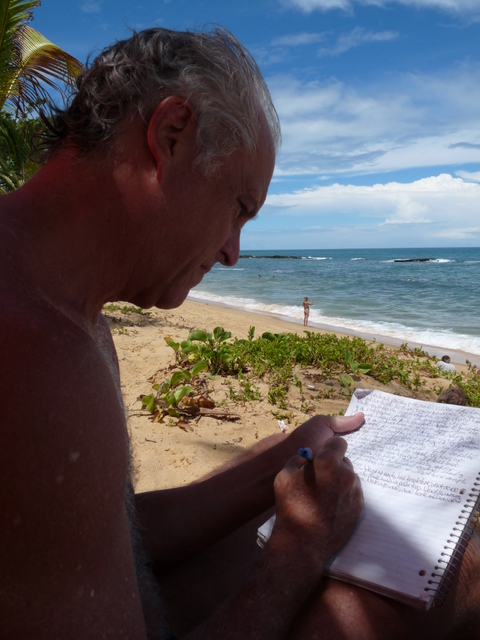
I devised Temporary Carioca while sitting on the beach. The early notes were hard to read, having spilled a beer on them while sampling tasty beach edibles under an umbrella at Ipanema. If I got too hot I was mere steps away from diving into body-temperature waves asking me to play. 

No question I was under the allure of the Brasilian gods, and now upon reflection I see the moments I describe in my six months of posts as truly  divined. Looking back, I am grateful to myself for the wisdom to write these posts.

With this last post I will move on to my new blog Michael Shandrick. 

So, I will now end Temporary Carioca until I once again am under the spell of a beach in Rio.

Thank you for reading,
Michael Shandrick

Thursday, August 2, 2012

The Girl From Ipanema Lives On

My favorite music growing up in Colorado was bossa nova. I listened to a lot of Sergio Mendez, Astrid Gilberto and Stan Getz, and of course this one, The Girl from Ipanema.

Performed by Frank Sinatra and Antonio (Tom) Jobin, the legendary song writer who wrote it in a nearby night spot, it remains a classic among their many collaborations. 

I never get tired of hearing Girl because it captured my young spirit in a way that country or folk music never could. And then one day -- some decades later -- I'd actually spend a lot of time at Ipanema itself humming the tune. I feel that I was rewarded in some way for persisting in what seemed like a far-fetched dream.

The Girl from Ipanema exists in song, memory and definitely in reality.

 "Yes, I would give my heart gladly but each day when she walks to the sea she looks straight ahead and not at me. Tall, tan, young and lovely the Girl from Ipanema goes walking and when she passes I smile but she doesn't see..."

Monday, July 23, 2012

Why Are Brazilians Always So Sad?


I wish I had so much more than words to describe saudade. A painter with a brush and canvas may do better. In Temporary Carioca I fought to describe the remarkable range of emotions I had never felt before, yet continue to feel after my six months there. Among those, there is one emotion I can’t get a handle on, saudade.

My first instance of saudade is the time when I heard the wheels lift off the tarmac and thump up underneath the body of the plane. I was startled that I was no longer attached to earth or Rio as the rest of Brazil fell away into the night. I could not turn back. I was now headed toward a distant place that would never recognize me as the same man who had left

I have tried to describe saudade and the best I can come up with is that this Portuguese word confirms a deep emotional state of nostalgic longing for something or someone that one was fond of and which is now lost. The word often carries a fatalist tone; it acknowledges that the object of longing might really never return or be obtained.

Saudade remains a vague and constant desire for something that represents a turning towards the past, or in my case, rarely towards the future. A stronger form of saudade may be felt towards a lost lover as a deep longing or yearning for a relationship which no longer exists.

Saudade may have prompted this writer to begin this blog, even as I was flush with all the amazing things I was to see every day. For I knew that someday I would be far away wishing I had written everything down.

Surely other writers have found themselves in Rio re-energized and re-made after having lost their way in the world only to feel saudade under the weight of knowing they would have to leave it someday.

Temporay Carioca is and was a recollection of places and events that once brought excitement, pleasure and well-being. Even thinking about these events can sometimes trigger the senses and take me back once again to the present, but only for an instant. Often, however, I am reminded these moments keep us locked in a past that no longer exists.  

Perhaps I was just an  intruder in Rio, foolishly in love with something that remains foreign and overwhelming while making me feel at home at the same time.

Perhaps I was just another in-between eccentric who may have endowed Rio de Janeiro with images I’ve collected but never the truth. Perhaps this is saudade.


Cabralia, Bahai


photo by Delma Godoy

Tuesday, April 24, 2012

Encounter Over Rio

I clearly remember the night of April 25, 2010. I had finished the dishes and put away the food. It was nearly 11:00.  I went out on the veranda of a house in Jardim Botanica, as I did on most warm nights to breathe in the cooler air. The stars and planets seem much closer in Rio. The heavenly sight always stirred me in a way as to make me sleepy. On that particular night the moon was 93% full gibbeous and huge lights shone over Christo's base and washed across the Corcavado. 

But on this night, two red lights blinked against the clear black sky. The brightness of the lights were much the same in scale and distance as Venus. They were high above and I had to crane my neck. They were certainly not aircraft. They were stationary, not darting around or zooming here and there.  But they blinked.

Below these lights I saw a new array of blinking white lights going in a circle under the initial blinking red lights. Then they began to whirl around like a sparkler in a fireworks display. I called to my girlfriend to come out to the  veranda. She had lived in the house for nearly 30 years and often star watched from here. She confirmed what I was seeing and she broke out laughing and calling her friends on the phone. 

Just then the lights began to criss-cross and turn more rapidly in a circle. This was followed by three more blue\white lights appearing below the red lights. The earlier white lights now blinked furiously. Then this display was followed by stationary white lights appearing one …two…three…four…five….all the way down to nine… at the end of a chain. The entire formation was in a straight line and neither moved laterally nor vertically. By now it was evident we were watching something beyond human.
  
We stood on the veranda breathless and enchanted, in awe and aware of something marvelous. We dared not take our eyes away. At 11:10, the white light on the very bottom of the cosmic neckless went dark. Then one by one each of the white lights slowly went dark from bottom to top. The white circling fireworks stopped. Each of The  rapidly blinking red and white lights went out, and finally only two, the original red lights remained. Then they, too, went dark.

Then it was over. 

Later we scoured the Internet to see if there were any other sightings around Rio -- and there are hundreds of new sitings each week in Brazil -- but nothing similar to what we had encountered. We looked for news reports. We had seen something inexplicable, and the impact was eerie. We needed confirmation.

Over the next week there was a meteor shower from the Pleiades but this display was feckless, distant and cold compared to what we had seen.

Ironically, it was on April 25 that Stephen Hawking’s documentary on alien life appeared on television. He discounted the idea that we will one day make contact with aliens. He said that a superior life form would simply not recognize us as anything but inferior life forms. Or worse, they might think we were a food source.

Also, that day,Arthur C. Clark was quoted as saying that making contact with aliens would be made more difficult for us because their advanced technology would be so superior that we could not possibly perceive their advanced technology as anything  "indistinguishable from magic".

And magic it was.


This video was taken in 2012 in Brazil and bears a sriking resemblance to our siting.


Monday, April 9, 2012

Crespucolo


Crespucolo was introduced to me at the beach. The word is used as a term describing the time after sunset and just before twilight. It is a time when the sun leaves the day to the evening. The sky reflects its light on the plazas, porticos and the still waters off the beach. And so much more.

 I also like to think of crespucolo as an attitude that is singularly carioca. The concept itself is something learned over a lifetime. It is like a persistent errant trickster who flaunts the rules and someone who cannot keep promises. 

There are people who are ardent watchers of crespucolo. They watch it unfold and yield its secret across a pallet rich in yellow, gold and pink purple sky, with a flash of indigo and red for the Carnaval effect. Each scene is a unique brush stroke within a delicate touch. There is nothing habitual or learned or sponsored.There is never any hurry.

I watch and wrap my feet in the sand, still warm. I let a cold wave wash the feet that brought me here. I start to leave and am told I am going too soon. I am pulled back by a hand. She shakes her head and tells me it would be a pity to leave so early. I would miss the final act and the encore. It is never the same.

There is something to be said about the waiting in anticipation and pausing for a final glimpse of the day. True to its promise I was surprised. I allowed myself to enjoy the significance of being a watcher, and now I am a temporary member of a club of people who strive to bring richer values to the canvas of life.

The scene continues to play out through the stages. I hear secondary sounds emerging from the night. I long for another moment like the last, but it is gone. I will come back someday with a strong sense that I have been away too long.

Monday, May 16, 2011

A Perfect Storm Threatens to Kill A Lagoon in Rio

At the beginning of autumn in the southern hemisphere, I walk with minha querida hand in hand around the Lagoa Rodrigo de Freitas in Zona Sul. The Lagoa is a constant source of inspiration since my arrival. Its mirror-like calm offers solitude amongst so much noise. The placid water stills the frenzy of the cars crowding the streets. 

Lagoa Rodrigo de Freitas

When the Portuguese arrived in the late 1500s, the local Tamoios called the lagoa Piraguá (motionless water). Later, the Portuguese landowners attempted to farm sugar cane on its banks with help from the tribes. Legend tells us that the farmers insisted on converting the natives to Christianity and making the natives wear clothing. They preferred not to and left. In any event, the farms never took root.

In the 1600s the lagoon earned its present name with the marriage of a local bride to a cavalry officer, Rodrigo de Freitas. Presumably the dashing young captain walked hand in hand with his intended on moonlit nights.

 photo by Delma Godoy 
gassa e logoa

Today, the lagoon serves as a focal point and forms the nexus of several rivers flowing from surrounding underground rivers fed from giant waterfalls in the hills. From the lagoon water spills out past Ipanema to the open sea.

On all sides of its 8k circumference, the lagoon supports a vast recreational community in one of the most densely packed cities on the planet. Each day thousands of runners, walkers, bikers and those on a promenade use every inch of the space. There are private nautical clubs, sports courts and an array of cafes, along with a busy heliport. Since Christmas 1995, a monumental illuminated Christmas tree floats across the mirror d'água, drawing thousands of spectators each night during Christmas.

What many paintings and tourist photographs do not capture is the severe stagnation and pollution below the water line. 

This is a longstanding problem. In 1922, it took the Centenary of the Independence to stir enough local interest to renew the lagoon and solve the problem. Inevitably, the lagoon was rebuilt but then it became severely polluted once again over the decades of government negligence. In the 1960s  a favela grew up along its banks until a fire destroyed it.  Developers moved in with landfill and began to build new luxury apartments and roads.

More construction is set to take place now that the lagoon is expected to become a jewel in the crown during the Summer Games in 2016. This is good news for the private clubs that have established themselves on the lagoon, including the Flamengo Club, the Brazilian Jockey Club, the Garden of Alah and the Naval Club on the island of the Piraquê.

Though a fisherman's colony barely survives near the edges - creating an illusion that all is well in the water -  the lagoon is a victim of chronic toxic waste.

Soon after Carnaval 2010, the lagoon began to smell badly. Days later, scores of boats appeared on the water with city workers pulling out 500-800 tons of dead fish. Early reports from the wildlife managers of the lagoon suggested that too much seaweed had robbed the water of oxygen during a period of high temperatures.

After this event, the water of the lagoon overrode its banks during the Easter floods, killing more fish and waterfowl. The lagoon could not revive itself. Nature had been overcome by seepage from old pipes pushing more contaminants into the sludge of the lagoon. The private clubs, restaurants and concessionaires have all contributed by dumping pesticides and other chemicals to keep their grasses and bushes green and bugs at a distance from humans. All it took, perhaps, was a record four degree rise in temperatures over the summer to set off the chain reaction.

The question to ponder for many who frequent the lagoon today: Would you let your child swim in the same water that killed thousands of fish? Would you eat a fish from the lagoon? If not, why should a bird expect to survive here?

 photo by Delma Godoy  

As I walk around the lagoon I see fewer waterfowl lining the docks. There are fewer flights of ducks and hawks. Only the scavenger birds fly now.  If you hear the call of a heron, count yourself lucky. When the fish and birds are gone, you are the only one left on the food chain.

Saturday, April 30, 2011

A Touch of Brazilian Magic


Throughout my stay in Rio I found that there was rarely a day I did not see or hear a futbol being kicked somewhere. All too often I could hear players yelling from a nearby club where balls bounced heavily on a concrete wall next to our bedroom.

Occasionally on the street I would run across a ball that had been kicked over a fence from a nearby sandlot. Wearing sandals I took my time kicking it back. At 40 Celsius I was contented to retrieve balls. Sometimes a ball found its way through a crowd at Ipanema beach, arriving at my feet, enticing the soccer player within to show his stuff. “Come on, man.” Instead I put a foot to the ball and made a simple pass to a dozen or more young people who had a lifetime of show-stopping heroics ahead of them.

Wayward soccer balls have always had a way of finding me, then urging me to come back to the sport if only for a moment of reflected glory. I had kicked makeshift balls made of rubber and clothing strung together, playing on a makeshift field near a village on the way to Mt. Everest in Nepal. Once I found a game in Guatemala City when a team needed a player to even a side. In Mexico at high elevation I played a portion of a game before the altitude got to me and they made me a referee for the rest of the game. In England I played games on a village road well into the night with two brothers keen to have someone to play with. As a youth in Colorado, decades before soccer became popular, I kicked a ball against walls and fences as a way of seeking equanimity in a turbulent world of my own making.

One night while walking along a beach in Cabraglia in the state of Bahai, I came across a game being played on a worn tennis court. The players wore old tennis shoes and some played barefoot, yet their skills were well advanced at a tender age. Then extraordinarily an errant ball flew into the air and bounced well out of bounds and came to a stop on the sand, confronting me. Giant waves from the Atlantic crashed not a few meters away in the last light of day. This particular ball dared me to take it ---skillfully. The young men were watching. I knew that local custom demands that when a ball arrives it is imperative to control it with style. Wearing sandals I flipped the ball on my right foot. Then I put the ball to my left foot and guided the ball back along the pavement, bringing it back to the eager players anxious to get on with their game.

I coveted the moments. This was no ordinary ball. It was the sum of all those feet that had touched it over its time. I passed on my inside left foot to their coach standing on the sideline 20 meters away. He nodded as he guided the ball effortlessly from his foot, up his leg as if it were on a string, bounced it on his knee and in mid-air, shot it flying back to the young men. The show was as much for me as for the players. 

With a respectful glint in our eyes two old warriors shared a touch of Brazilian magic with the future, the present and the past.


 Photo by Delma Godoy

Along a beach in Cabraglia

Tuesday, September 14, 2010

Lula's Spending Spree Catches Up To Brazil


Rousseff 's & Lula's Big Secret

Over the past couple of years President Lula been active on a farewell tour of the world proclaiming new social programs he sponsored in the name of international charity and goodwill. Lula hopes the history books will be kind to him.

Subsequently, he lent Fidel Castro billions of Reals to rebuild Cuba’s crumbling cities. Lula gave Reals to build roads in Bolivia and spent billions more in Venezuela so Hugo Chavez could rebuild the transportation system. Lula also forgave 700 billion in defaulted loans to several African states.

While he was on his multiple worldwide tours he was also brokering trade agreements, including business deals to bring nuclear energy to Brazil, as well as creating more hydroelectric dams in the Amazon. He made an agreement with the Russian space program for future space exploration. In all of these agreements, Lula rarely disclosed the amount or terms of these deals to his government.

Claiming national security reasons for his fiscal privacy, Lula invoked medidas provisórias, a measure which would allow him to act on behalf of the government without Congressional approval. Yet, legislators were concerned, because medidas provisórias was mandated by the Constitution only to be used as a tool by the executive branch to assist in making quick decisions in times of emergencies.

Yet, while Lula was traveling and proclaiming Brazil’s bright economic future, he never spoke about any “economic emergency” in Brazil. In fact, Lula was presenting Brazil’s economic miracle to the world in the best possible light. He even used the measure to improve the publicity concerning a Formula One race being held in Sao Paulo.

In the past, medidas provisórias was used by former president Fernando Henrique Cardoso in his first term just three times. The Real was under stress and devaluing during a time of high inflation. President Cardoso used the measure to bypass Congress to stabilize the Real using medidas provisórias. His quick actions eventually created the bedrock that would lift Brazil into prominence as a world economic power.

 Former President Cardoso

Lula, who led the opposition against Cardoso at the time, charges that Cardoso was becoming a dictator. Years later, Lula adopted Cardoso's economic framework himself and used the controversial measure 16 times in his first term. Since then, as president, Lula has used the measure on average of four times a month.

As much as Lula tried to hide his government’s fiscal management, it eventually came to the surface near the beginning of Lula’s second term on April 7, 2006. Minister Dilma Rousseff, acting on behalf of Lula’s government, made a decision not to loan VARIG, the beleaguered national airline, any more money to operate. Lula was busy telling everyone else in the world about Brazil’s economic muscle while Rousseff was secretly telling VARIG Lula could no longer support the company because the government did not have the money. VARIG, a respected airline, which dates back to the origins of aviation, was out of business, and 11,000 jobs were lost in Brazil. At the same time, Lula came up with $R 170 million to pay to international bankers as interest on overdue loans.

Of course, much of this information is conjecture and based on rumors and speculation. This is because the Lula government was operating in violation of the government’s own fiscal transparency laws. The media never complained and few judges would go against Lula in the courts and investigate these claims of corruption. And nothing changed. To Lula, there was simply no reason for transparency simply because he did not feel he was accountable.

Initially, there was protest led by Jose Serra, an opponent who had lost to Lula in 2002 and again in 2006. Serra called for an investigation by the Judiciary saying that Lula’s financial chicanery was a clear violation of the Constitution. Without the support of the Lula-dominated media, the protest came to naught.

On the eve of the 2010 election, the powerful Lula government propaganda machine continues to promise a prosperous future that would be fueled by vast oil deposits, nuclear power generation and hydro projects in the Amazon. However, the world is watching closely. The experts understand that Brazil’s promise is not immediate. It could take another two decades before Brazil could generate enough electricity to determine affordable market prices and reasonable costs to the average consumer. In some quarters, Lula’s promises for immediate revenues are sounding hollow.

Currently, much of Brazil’s economy remains based on its exports, but the country no longer has the leverage it once had because inflation within Brazil is hurting foreign sales with higher costs. Traditional revenues from its cash crops are slumping as the worldwide recession continues to linger, and other countries such as Vietnam, China, Turkey and India continue to batter Brazil with competitive pricing.

 Presidential Candidate
José Serra

José Serra and Dilma Rousseff may never meet in an actual debate. If they did, a couple of questions would determine each candidate’s approach to the next government’s economic policies: How will Brazil pay its bills? If Brazil were to default on its loans, what will the government do?

This election is not about the economy, but it should be. Perhaps this is why former president Fernando Henrique Cardoso decided to make a rare appearance recently on the Internet. Events have reached such a critical moment that Cardoso felt it was necessary to come out of retirement to warn his countrymen of the impending economic catastrophe that awaits the next government.

Cardoso, who is the architect to bring stability to the Real, led a government which went on to lead Brazil’s booming economy into the new century. Cardoso warns that the present government has acted for far too long as if it were making simple transactions. He says the matter is not about fiscal privacy. It is about disrespecting democracy. By continuing to circumvent the Constitution and ignoring the laws of Congress the “current president” has shamefully abused the voters and the election process. There will be serious economic consequences, he adds.

By the time of the elections, the voters themselves will be feeling the pinch of an economy gone sour. All across Brazil, the department stores in shopping malls are losing retailers. Restaurants are closing and cultural events are losing attendance. Auto sales are decreasing while basic costs like grocery items are increasing daily. Imported goods are fueling inflation. The roads are still not fixed in Rio and in other large cities more and more people are out of work incapable of paying their bills. Little or no work has actually begun on the large number of ambitious infrastructure projects promised to be completed for the 2014 World Cup or the 2016 Summer Olympiad.

What if Brazil does not have the money?

Friday, September 10, 2010

Brazilians facing a strange election

President Lula

On October 3, 2010 a presidential election will begin in Brazil. It will be the most important election in the country’s history. At stake is the country’s economic growth, its social policies, its civic institutions and democracy itself.

The outgoing President Lula will leave office basking in unprecedented popularity, backed by the powerful media elites he pretends to despise.

Harboring a long-standing problem with alcohol, Lula spent more time traveling than running the country. He made some 102 travels amounting to 382 days out of the country and 602 days away from Brasilia, the country’s capitol. Lula spent 984 days out of the Palace of the President. In total he spent nearly 82 percent of his mandate of 1,201 days traveling instead of governing the country.

Lula is inarticulate, choosing base words and crude antics when he faces opponents. Many educated people say his Portuguese is poor, and his grasp of the language is seldom above a grammar school level. Yet, Lula has effectively positioned himself as a peasant fighting the elites to make up for his intellectual defects.

Lula is nothing if not a showman. He did not wait to leave office to introduce a motion picture of his life in October of 2009. In the bio-pic, Lula, he was portrayed as a poor boy rising to the most powerful position in the country.

During Lula’s past eight years as president, he has based his economic and social policies on those of his predecessor, former president Fernando Henrique Cardoso, the man who first brought stability to the newly democratized Brazil. The Lula government, however, has claimed all credit for Brazil’s growing economy and has blamed the country’s faults on Cardoso’s previous administration.

At the same time, Lula’s government has spent ten times more than the Cardoso government had spent in its two terms. His excessive spending has drawn little criticism, as both houses of Congress willingly grant the president any amount he wishes.

Should he face any serious opposition for his policies, Lula will use secretive executive powers to circumvent the constitutional process if necessary. Recently he over-ruled the Judiciary when several judges made court decisions that opposed the construction of the Bel Monte damn. Not only has this caused a constitutional crisis that is still unresolved but the construction continues under a cloud of jurisdictional confusion.

Perhaps his most notable impact was made recently when he announced Dilma Rousseff as his successor. This in itself should have been a controversy, but Lula’s control of the media has made her untouchable to complaints. A recent law was passed in Congress forbidding any criticism or unnecessary scrutiny of the candidates for this election, including satire. Rousseff’s opponents now must debate her with their hands tied by executive order of the president.


Heir apparent, Dilma Rousseff

Ms. Rousseff, though intelligent, is not a crafty debater and often is perceived as clumsy. In response, the election debates are highly orchestrated. In some cases the videotapes are heavily edited to make her appear as the preferred candidate before they are released to the mainstream media. She is never available for sound bites or spontaneous discussions among the public or media.

Rousseff is a woman who has been plucked out of nowhere to be the next president of Brazil. She is paraded around by Lula as his successor and all but crowned as the new president. Lula claims she is winning the election by a margin of 50 percent to 29 percent in the polls.

All that is known about her is that she has some minor legislative experience and did not rise from the judiciary. She does not have a strong enough power base to become a senator and her legislative goals are murky.

At times, Rouseff appears to some skeptics as a novelistic character whose past has been rewritten to fit the times and circumstances. She has prospered under the wing of her mentor, Lula. She has steadily moved up through government as an appointed minister and has, like Lula,  taken on the guise of a misunderstood public servant; just another common person who has made good.

But even as her controlled election campaign continues unopposed, there is more evidence she was a middle class radical who later became a terrorist. Much of her history been lost under a new narrative created for her by the state-controlled media: This new Dilma has been redeemed and resurrected as a better person. This is a popular theme in a country dominated by Catholics.

Rousseff, herself, has refused to discuss her redemption or her mistakes of the past with any credibility. Rather, she has undergone several makeovers, softening her once unpolished and frumpy public image into that of a modern, well-to-do elitist on the move up.

Often, her color photos appear on the fashion magazines as a perky government leader. In this capacity she is interviewed more about her choice of toe nail polish than she is of her beliefs about her priorities for governing 290 million people.

While she has been effectively sheltered by Lula, from time to time reports emerge from the Internet that reveal a different Dilma Rousseff.

These reports document her association with guerilla groups in the 60s and 70s, when she was involved in murders, bombings, assassinations and bank robberies. Most notably, it has been reported that she was briefly imprisoned and was released without receiving the same treatment as her conspirators, who suffered much longer prison terms and torture. Some reports indicate that she took more than R$2.5 million from a bank robbery and used it to fund her fledgling political career.

 Dilma the guerilla

Most of these claims are disregarded by the mainstream media. The opposition has only hinted of a dark past with few specifics. In any event, there is no public outcry for a full investigation about Rousseff’s past.

The only stain on her rise to power may have happened during the first week of September when she appeared at a political rally with Lula. When she came out the crowd continued to cheer: “Lula, Lula, Lula” . Lula gloated despite efforts of the organizers to make the crowd yell “Dilma, Dilma, Dilma”.

It may be that her only opponent in the election will be Lula himself, who is showing signs of reluctance about leaving office. He seems unwilling to relinquish his place in history to his successor. This makes many in Brazil fearful that Rousseff will be the puppet and Lula will pull the strings. This reminds many of a well meaning politician in Venezuela who promised democracy and turned it into tyranny: Hugo Chavez.

Monday, July 19, 2010

The Art of Being Empty

pensamento mudo


Lygia Clark


After watching my inspiration turn to ennui recently, I received a note from my Muse, herself a highly respected plastic artist and painter in Rio. It was about Lygia Clark, a Brazilian plastic artist who frequently explored the emptiness of form in her work. Clark wrote that artists must not worry when they feel empty, because this is a natural condition for creative people.

Only when an artist is full are they ready to create, much in the way a person eats too much and they explode (vomit) in a furious burst of creative and emotional energy. What results is a large amount of painting, sculpture, music, etc. coming from the artist.

Filling up, Clark adds, is a process that takes time. It cannot be conjured up on a schedule; it means painfully collecting inspiration from routines among daily life: washing the clothes, taking walks in the neighborhood, having a quiet coffee in a shop alone, buying groceries, or just sitting on a bus while returning from work.

This is good to know because I often putter, waiting for inspiration to replace the emptiness. This means I cook, clean, sort, walk, nap, ponder, and move objects around a small basement apartment.

By contrast inspiration is a feeling of fullness. Often, but not always, the words begin to flow like water coming out of a fire hydrant. My best writing comes from making myself a “full” vessel, allowing the gods to pour their words into me.

Then for the next few days and weeks the cat or dog may not get fed. If I do buy food I might leave part of the groceries on the bus, along with gloves and umbrellas. The laundry does not get done. No one is dusting or vacuuming the carpet. I seldom make good conversation while full of inspiration. My circle of friends gets smaller.

In my fullness my characters jump off the page; they are extraordinary in their hopes and desperately seeking something beyond their grasp. They love and want to be loved. They face conflicting motives by what they try to conceal during the day and what they fear losing at night. They make a journey of discovery and then rapidly fade to black.

Implied in Clark’s statement is the notion that inspiration is found in daily life and that life itself is art.


Tuesday, July 6, 2010

Reality Returns In Brasil's World Cup Loss


Even Christo on the Corcovado opens his arms in frustration trying to coach the Brasilian team to the 2010 Copa. You can see the disappointment on his face.

My friend tells me that players from Paraguay, Chile and Argentina were warmly cheered by thousands of fans when they returned to their home airports. In Brasil, however, the players were forgotten by their fans and their coach was fired soon after returning home. The media is now creating a new tempest by arguing about the hiring of the next coach. My friend says that Brasil really doesn’t need a coach. “Everyone in Brasil is a coach.”

She is most pleased that Brasil is not playing in the finals of the 2010 Copa. “Now the country can get back to reality.” By this she means the people can begin to look more carefully into the upcoming elections in October, because President Lula will be deprived of taking all the credit for coaching Brasil to the World Championship. “Lula has claimed credit for everything else in the country, why not the Copa?”

Lula was openly critical of Dunga as coach before the Copa began and now has no one else to blame. Hopefully the president will turn his attention to inflation, joblessness and corruption, which is a principal issue in Lula’s presidency, she says.

She and many others want the media to investigate Lula’s manipulation of finances in which he chose not to support Varig, the struggling Brasilian airline, claiming a lack of funds but then decided to spend vast sums of taxpayer money to revitalize Cuba’s depressed economy. Lula also gave licenses to international corporations to exploit the Amazon’s mineral and hydroelectric wealth, while telling the world press that the Amazon is Brasil’s problem to resolve and other countries should stay out of its affairs.

My friend is relieved the people are no longer swept up in futbol and hopefully they will turn their attention to the lies Lula has painted blue, gold and green recently.

As the 2010 World Cup winds down there are still the occasional vuvuzela (horns) blaring from apartment houses, a few fireworks here and there, and some cheering from the noisy sports club around the corner. My friend would prefer people in Rio give up their love of futbol entirely.

No political movement or religious organization commands a greater loyalty than futbol in Brasil. But this is a kind of hypocritical allegiance because the disillusioned fans are already dismantling the old structure before it falls and drags everyone else with it. Because futbol demands such conformity, my friend argues that it takes away attention from important issues, such as building a sustainable and prosperous culture.

The odor of Brasil’s exit from the Copa will leave a bad taste on the tongues of futbol fans for another four years. And my friend is already thinking about leaving Rio for a month when it hosts the finals during the 2014 Copa Mundo. Carnival is noisy enough for one year.

For the next four years the Carioca will have to find joy in other pursuits. This would leave only samba, the beach life and beer as the other gods people pray to each day.

Wednesday, June 23, 2010

Secondary Sounds


In Rio, I listen to a rich tapestry of sounds, most of them unfamiliar. One night, walking near a wild congress of waterfowl calling to each other I felt privy to an on-going ritual, a private conversation among the invisible life in the trees and grasses. I imagine that the gassa calls from its perch each night from the dense brush surrounding the lagoa. This is as close as I get to a perfectly natural nocturna, just twenty meters away from the rush-hour noise.

In the morning I listen to the birds chirping outside the kitchen loft. Children arrive early down the street for a long day at school, most of it spent singing and laughing by the sounds of it.

On important holidays and days following large storms, the streets are quiet. Whenever Batafogo or Flamengo is playing there is an eerie stillness in the street until a team scores, then the noise shakes our house from a cheering chorus of fans.

One of the most interesting sounds I’ve heard is that of a flying insect who sings her death song shortly before she ends her short life with a sound much like feedback from a musical amplifier. On one occasion I was at an outdoor restaurant overlooking a vast nature reserve. Looking for the source of this sound I looked to my right and immediately saw a four-foot lizard walking out of the bushes with something in its powerful jaws. It looked at me like I was on the menu and then turned back into the brush while all those the piercing insects continued their song of life and death.

Other sounds are more familiar, like a samba drum practice band in a park or a solitary bossa nova being played from a beginning guitar player and occasionally African singing from a nearby club. At night, these sounds are mixed with the incessant yelling from the indoor futbol players next door who kick their soccer balls against a concrete wall. Caught in between these sounds I try to find my way to sleep.

Then there is the sound of waves crashing, mixed with the murmurs from hundreds of casual conversations in a language I do not understand. There is serendipity in the voices of vendors calling to us with a fresh batch of their tasty treats. This is all possible because of a ban on loud music on the beach. Here, there is a serenity only a beach lover would appreciate.

With so many people living cheek by jowl, there is a significant noise problem in Rio. There are several noise hot-lines which register complaints, mostly about late-night clubs that stay open well past midnight. The police say they are powerless to control noise without laws that are enforceable. But really all anyone can do is to relish the silence between the notes and remember to praise silence where it exists – while focusing on the secondary sounds, the ones that seem less like noise.

All photos by Delma Godoy

Sunday, May 30, 2010

Jesus...what a swindle


Every day the Carioca look up to the Corcovado and see the statue of Christ holding his arms outstretched to embrace his flock below, including the gang members who rob tourists by legal means.

Christ is the forgiver who grants grace and redemption to the sinners. He is also a brand of Rio de Janeiro. Millions of tourist trinkets, paintings, beach towels, ashtrays and photographs are sold in his name every year. And now he is becoming a Jesus Park, a comical blight that draws thousands of tourists, who are being taken advantage of by the very Shepard they seek to protect them.

Ever since the statue was named one of the most popular icons of the modern world there has been a transformation of the Jesus business in Rio.

This came to light soon after Carnival when the statue underwent its annual renovation. The symbol of Rio was cloaked in a web of steel as workmen built scaffolds so they could sandblast the exterior and reinforce the interior enough to withstand everything that nature can throw at it, including lightening strikes and winds.

Work on the statue was temporarily suspended, however, due to record April rains that closed the roads leading up the mountain. The cog train, whose tracks were under the threat of being washed away, had closed and new earth had to be trucked in to rebuild the various sections to the summit.

But something else also transpired during the closure: the road was re-opened to taxis and a private van service, which had evidently won the Christ conveyance concession. Now, to get to the statue you have to pay an exorbitant fare.

On two different ascents my companion drove me up the road as she had done on numerous occasions for visitors from abroad. And twice we were turned away by security, despite being assured by the tourist office that the road was open to private cars.

My companion, skilled in both English and Portuguese profanity, let her opinions be known, as we watched a parade of taxis, vans and “preferred” cars driving up with impunity. “Corruption. Robbery,’ my companion declared.

We made our way back down to the train station, determined to see the statue, but found the train was still closed. Only the ubiquitous white vans and taxis offered a ride and we soon saw that the price had risen rapidly from driver to driver, like brokers on the floor of a commodity exchange. One price may only take you to the foot of the statue, but not return you to the bottom. Another price may offer you a return trip, but not charge the entrance fee to the actual park. “Imagine what they do to tourists who cannot speak Portuguese,” my companion said.

In the end we opted for a evening view of the statue from our veranda and enjoyed a nice meal with the money we saved by not making the journey.

I had always enjoyed the view of the Redeemer morning, noon and night, rain or shine from our window. I marveled at a breathtaking monument that continues to stir the soul, but I decided against any further attempts to scale the Mount in a van or taxi. I didn’t want to despoil my feelings by getting fleeced at the feet of Jesus.

Tuesday, April 20, 2010

When A Tree Falls in the Amazon...


I stood under a massive tree much like those under the threat of extinction in the Amazon. It was among many other trees planted by a group of Portuguese military officers who operated a gunpowder factory in Rio de Janeiro around 1800.

Among these men were botanists who saw the threat of extinction of many flora and fauna in the region. The threat came from plantations destroying vast tracts of land for the cultivation of coffee, sugarcane and many other farmed crops. Near the factory the botanists began collecting some 6500 different species of trees and plants under the threat of extinction and created a space where subsequent generations could one day come and observe nature. The space opened to the public in 1822.

I was dwarfed by the magnanimous efforts of these foresighted men as much by the tree I stood under.

Bounded by steep granite hills and deep lagoons and bays, the city of Rio de Janeiro has since been preserved as much by tourists coming to the region as by the foresight of those early botanists who felt a need to protect the environment many years before it became necessary.

Today, Rio’s Jardim Botânico is hemmed in by a rapidly growing city ravenous for space. This garden is an anomaly in an urban area that is equally colonial and newly modern, with a predictable lack of harmony. Beautiful colonial walkways and buildings fall to the plunder of mixed modern architectures as quickly as trees fall in the forests to commerce.


Here, there is a sense of cool spaciousness under giant trees sheltering walkways from the tropical sun. Water flows along stone channels built to water the garden. The space is a sanctuary for birds and monkeys and an occasional tourist searching for a refuge from the everyday world.


For a moment I understand I am a part of a mystery as an inheritor of the natural world and not its master. Listening to the birds I am pleasantly devoid of hubris, if only temporarily.

But still, I cannot imagine true bio-diversity in a place like the Amazon, where every cause of discomfort has its equal in a cure, and where there is balance in the same way a flowering plant provides the antidote to a mosquito borne in a nearby pond.

Modern man has no language or experience in bio-diversity. We would not survive for long in a place like the Amazon. Perhaps this is why man needs to destroy it.

The coming devastation planned for the Amazonian rivers and trees will remove what has been there since the beginning of the planet. Many natural remedies will be swept away by the all-powerful hydro people who bring concrete to solve a problem without considering other more efficient means of energy generation. Bio-diversity will be drowned in the floods created by dams.

Bio-diversity is the promise of a healthy planet; it is based on the notion that everything is here because it is intended; nothing is out of place, except for humans who have no tradition of respect for the natural world.


Perhaps there are those in power who will notice that the entire Amazon needs to be preserved in the same way their ancestors kept nature sacred for our generation.

Photos by Delma Godoy

Monday, April 12, 2010

The Floods of Easter

Currently, there are some 200 dead, with perhaps hundreds more missing, as mudslides continue throughout the City and State of Rio de Janeiro.

Most of the 50,000 people who are currently homeless live in poorly constructed slum housing built on or near mountainsides. They are part of the 1.5 million poor who live in favelas, which comprise 20 percent of the City’s population.

The rains came Monday afternoon, April 5, following a sultry, quiet Easter Sunday with 90 percent humidity. For the next 24 hours the biggest rainfall in the past 25 years was recorded.

Up to this point the city’s plan worked well enough to divert the water during recent storms. Unseen, however, was the shoddy new modern construction that had over-taxed a fundamentally weak city infrastructure, originally built early in the last century.

Hidden underneath the surface of roads and sewers already strained to their limits were whole sections of land built on landfill comprising garbage dumps and crumbling concrete. On the hills, the problems were magnified by massive deforestation by people living in the favelas.When the mud flowed it took homes and people with it.

While the government points to its achievements featuring elegant modern buildings being constructed in the city proper and to the rapid expansion in the middle-class suburbs, next to nothing has been done about the long-standing problems of housing for the city’s poorest.

This coming October, voters – including people living in the favelas – will go to the polls to elect a new president and new leaders, each of whom is busily promoting their recent achievements in bringing the World Cup and Olympic Games to Rio, along with developing new off-shore oil.

The politicians boast they will have some $7 billion to create a city worthy of hosting the Cup and the Games.

Little mention has been made about how much will be spent for building new housing for the homeless.

The rains continue to fall on the poor and the rich, alike.

Wednesday, March 31, 2010

March 31 - A Day Remembered


Tanks roll in military rule.

March 31 is a rueful date in Brasil’s history. On that day in 1964 people disappeared, civil liberties were suspended, hard-won freedoms were lost overnight. In what was supposed to be a temporary transition the military coup turned into two decades of oppression.

Teachers were hauled away, while actors and poets went into exile. Students who had pushed hard for social reforms were tortured and killed. Their textbooks were heavily edited to support revisionist histories. Film makers and writers had to be clever to make sure their work got past the censors and still had relevance.


A million people march for democracy in 1968

Not surprisingly, the poorest suffered the worst, with nearly 50 percent of the population living in the favelas on less than a dollar a day. The slums quickly spread across the large cities, while foreign multinationals profited from Brasil’s rapidly expanding economy. Education was limited to the privileged, while babies borne by the poor seldom lived to five years of age.

While the US and many nations in Europe had 200 to 500 years to develop their political systems, Brasil has had just 23 years of democracy.


Students push for a new democracy in 1987

A month ago 150,000 people in Rio gathered in a driving rainstorm to protest a proposed government policy. In October they vote in their country’s most important presidential election. Brasilians are moving at light-speed to a future no one would have predicted forty-six years ago.

Sunday, March 28, 2010

An Hour of Perception


As the Hour of the Planet approaches I lay on a small pier watching the southern stars with my companion. On most nights the stars steal the show, but tonight they hide behind small clouds that look like poodles.

Directly above, a 90 percent gibbous waxing moon casts her spell on the water, which ripples from a welcome breeze.

The placid water holds the reflection of lights across the lagoon. The restaurants are full of people talking. Traffic horns and sounds of bossa-nova waft in and out of range. The herons call to each in the dark. Life goes on.

The Christ on the promontory turns off for 60 minutes. The breeze blows out our candle.


Photo by Delma Godoy

Tuesday, March 16, 2010

Carioca Dolphins Swim Free in Rio's Ipanema

A dozen dolphins were caught on film swimming in high seas off Ipanema Beach in the Zona Zul District of Rio early Tuesday morning, March 16.

Initially, the pod headed towards Leblon Beach then turned back. Known for their near human speech patterns, they were heard to say “Not My Beach” and swam back to Ipanema, before heading toward the Cagarras Islands.

Thursday, March 11, 2010

This is My Beach


There is a saying among the Carioca, “all things die on the beach in Rio”.

I contemplate this phrase as I walk along the shore, with either beer or coconut milk settling in my bloodstream. At sunset couples walk hand in hand, children laugh as they run in and out of the water, soccer balls fly and bounce with impunity. Off shore the sea may be gentle, warm, light green waves in the last rays of day. Occasionally, the sea is rough edged, dark and forbidding, landing near your feet on shore with a thud.

Everything on the beach is temporary and casual, the result of unspecified but obvious rules. The beach has outlived bans and survived legislation because it is a culture where grandiose plans, straight lines, goals and trivialities are shed with the next wave.

Here at the edge of the eroding continent is a place where men cannot build castles. Instead, the people erect fantasy in the clouds. Here, the flesh is unleashed and the body is freed when the street clothes come off.


Not unlike a tribal community, denizens of the beach are made up of people who are territorial. They carry on traditions honed over the decades by staking out a place on the beach in the company of those they enjoy. There is the Globo television set, the fashionistas, the journalists, the business elite, artists, and the body cult. They find their spots along Ipanema, Copacabana or La Blon.

With two million people at the beach on weekends in the summer, a vast community is nowhere else but the beach. The regular life is forgotten. People who are not working the new, new thing are looking for friends or a place in the sun, an umbrella, a chair and a vendor to keep them supplied with tasty treats and beer for the duration of their stay. They sit for hours, often with people they may never see off the beach. By some instinct - perhaps a survival technique honed through generations – these sun worshippers remain relevant and secure in their place. If threatened by petty annoyances, they leave with a simple phrase: “It’s not my beach,”


With all this in mind one day I throw a handful of hand-written daily intentions into a wild sea hoping to find a generous god who will deliver them to the appropriate Shepard. The paper notes are quickly sucked back into the waves. Perhaps dreams don’t die at the beach.
Photos by Delma Godoy

Thursday, February 25, 2010

A Carioca's First Carnaval Street Festival


With sleep still in my eyes, I stumble down to the corner one Sabado morning expecting to see a small band of local people celebrating a street Carnaval, one of many in the city. Instead I see a large samba band, a huge sound truck and hundreds of people in costume emerging from the shady borders of the street, including young and old dancers from Bahai performing in their traditional costumes. A group of young males wearing tight pink dresses dance among costumed females in their scanty plumage. Both sexes wear what can only be described as fantasy, as they march to the beat of their own drum, like Soshia Obama, parading as the US president.


The beer vendors on both sides of the street are doing well and soon I find a SQOL in my hand watching the crowd become one swirling tribe. It has achieved concentration. As if on cue, the music stops, The drummers take a breather. It is 45C at 10 in the morning. I’m down to beach wear. The break is just a space between the notes. Then suddenly the drums begin again and the mob contracts like a giant serpent and explodes into action. Several thousand faces are illuminated with smiles. The line between the crowd and the participants is merged into one electric samba.


In coming days I join two other parades. Again, the drumming and dancing pull me in with surprisingly ease. I am anonymous, a simple organism drenched in a flood of sweat between male, female, black, white and caramel enamel. I am swinging to a worldly synchronization I only half understand. The movement is chaotic, calling all to shed conformity.


We are a mob, cheek by jowl. The samba is seductive and pulls you in, but she is a fickle goddess and lets you go to your other life without a kiss. As the dance moves on I take a dip in the ocean to cool off. I dive under a dark wave, believing a conversion requires a baptism.
The wave throws me back on the beach, like an uninvited guest. I brush off the sand and listen to a beat in the distance.

Photos by Delma Godoy